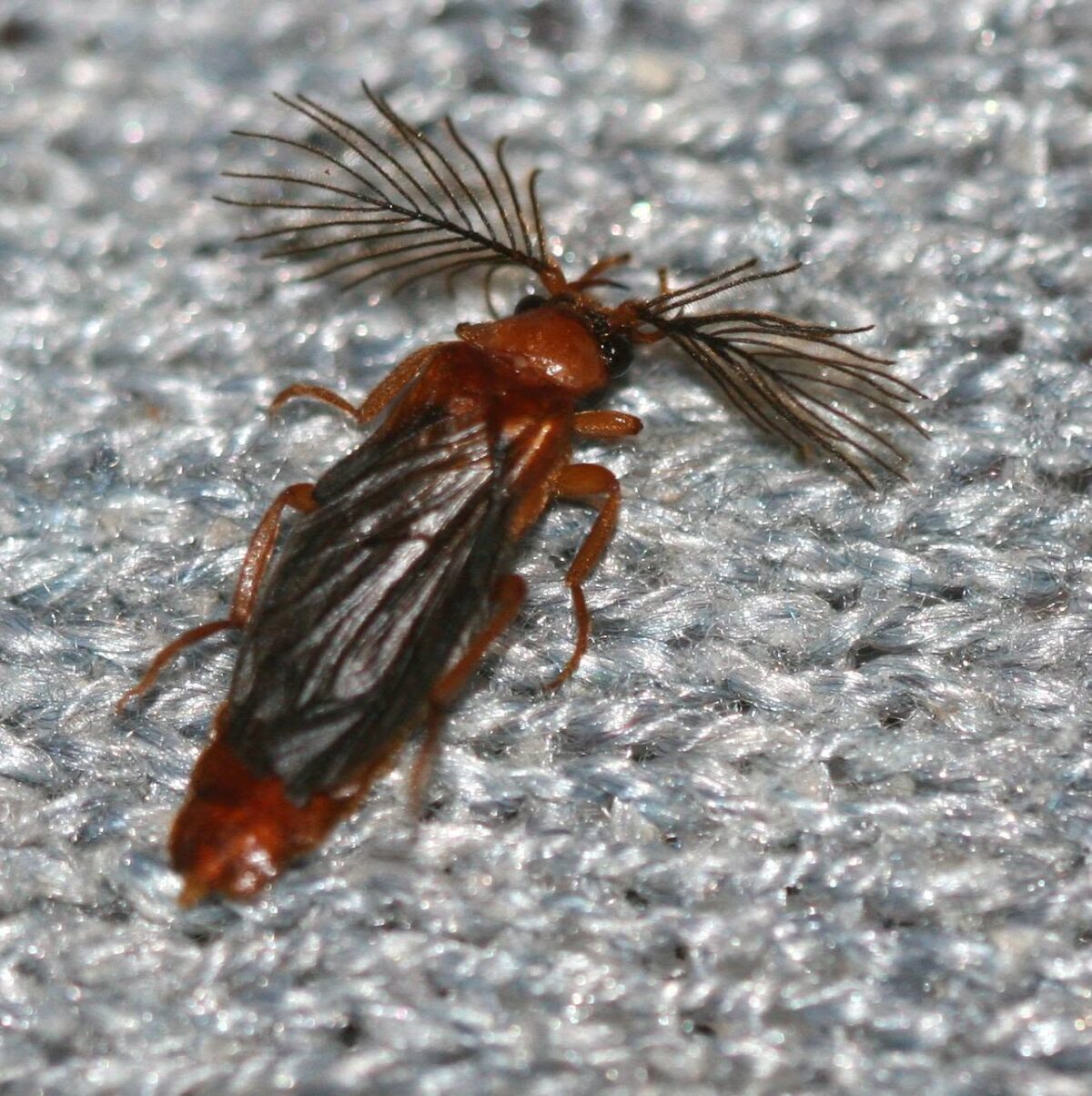
A few years ago a most peculiar insect flew into my office and landed on my sweater. Its antennae were huge in comparison to the size of the insect. I contacted my friend Eric Eaton who is an expert entomologist who told me I had a male Glowworm Beetle. He gave me this link with scientific information about this glowworm.
I recall going fishing with my family on a riverbank in Indiana at night as a child when my mom commented on the Glowworms on the river bank. Had it not been for that experience, I would have had no clue about Glowworms.
I still have some unanswered questions. I spent some time this week trying to learn more about them. I learned that the larva stage glows in the dark. Females continue to glow in the dark and their appearance doesn’t change much from the larva stage to the adult stage. They don’t grow wings, but the adults have only six legs. The large antennae and wings are only seen on the adult male beetles.
I grew up in northern Indiana before we felt the need for an air conditioner. The only phones were connected by wire to a phone jack on the wall. The earliest phone I remember was a wooden box attached to the wall. We turned a crank to get the operator and told her who we wanted to talk to. Then she connected us to their line.
The only mail we got was delivered to our mailbox every day. Email was unheard of. In my earliest years, there was no TV, only a radio. I remember sitting on it so we could hear it with less static.
Before anyone finds a reason to think of me as deprived, I insist that the exact opposite is true. I had the privilege of finding newborn kittens in the barn, hunting morel mushrooms in the woods, floating in an animal watering trough in a swamp in the middle of a field, sitting in an apple tree and discovering a stick that turned into an inchworm. I found another stick that was really a spider. I could go on and on.
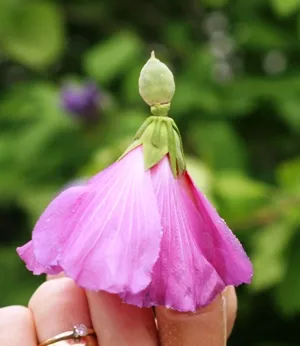
When I was a little girl in Indiana my aunt showed me how to make a doll from the flower of the Althea Rose of Sharon bush. It grew in the front yard of our farm. The petals made a lovely long dress and the doll’s head was the unopened bud of another flower. A few years ago we were visiting my husband’s family in upstate New York when I noticed the same flowers blooming all around and took advantage of the opportunity to make one again.
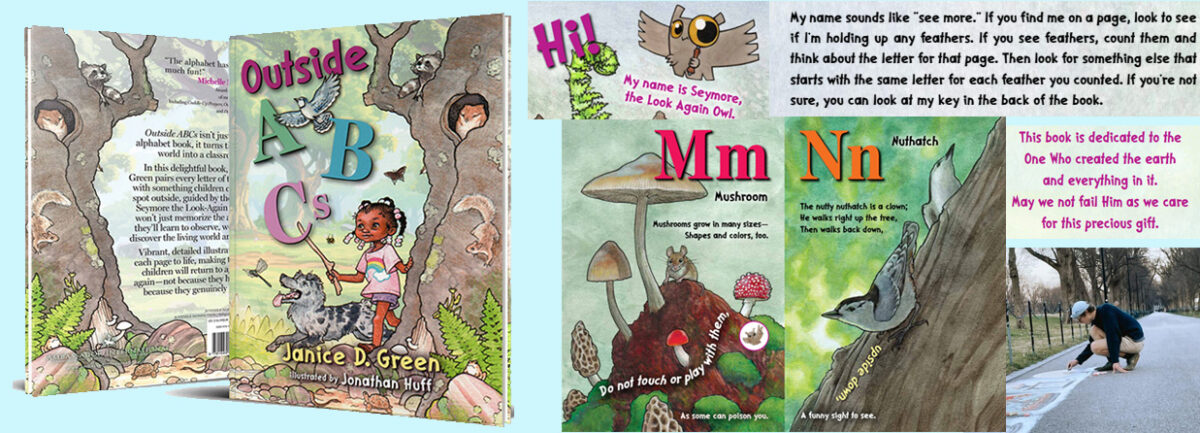
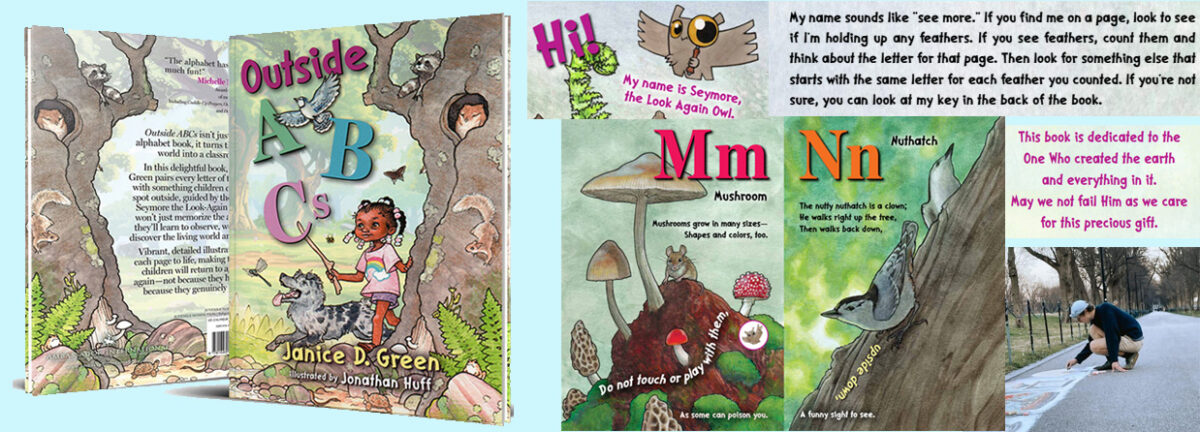
I am beside myself with excitement! Outside ABCs released in April 2026. My gifted grandson, Jonathan Huff, is the illustrator.
These are the fantastic endorsements that were written about the book, even before Jonathan Huff’s amazing images and Ambassador International’s whimsical layouts were applied:
“As kids follow the alphabet, they will not only learn interesting facts about nature, they will also be inspired to explore the great outdoors. Did you know fiddleheads are a sign of spring and that velvet ants are wasps? Written in whimsical rhythm and rhyme, Outside ABCs is interesting, educational, and fun to read. The illustrations are creative, bright, and colorful and will capture the attention of every child who opens the book.” —Crystal Bowman (who also has had a chance to preview the completed PDF file with completed layout)
“The alphabet has never been so much fun! Janice Green’s Outside ABCs is a wonderful alphabet book, teaching children so many fun facts all written in effortless rhyme. The author’s descriptive language and rhythmic writing make this book a great addition to any library.” —Michelle Medlock Adams
This post was originally written for Christian Children’s Authors blog. I needed a post for April 17. When I discovered that April 17th was National Crawfish Day, I knew it was time to check off one thing that had been on my bucket list for years – to catch a crawdad in a crawdad hole.
Everyone knows about finding crawdads in creeks and ditches, but did you know you could catch one in a hole in the ground with a string and some bacon?
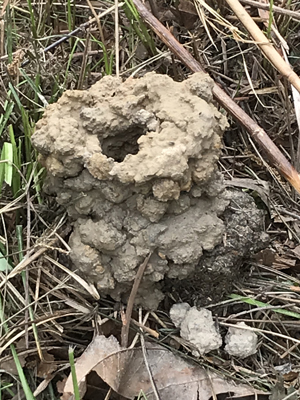
Many years ago when my now-grown daughter (Jonathan’s mom) was very young we saw several funny looking chimneys made of mud in our back yard. Not knowing what they were, we asked around and were told that they were made by crawdads that lived under the ground. I often wondered if I could catch one with some bait on a string, but I never got around to trying it. Many years later in a different home in a different town, I noticed mud chimneys in our ditch.
It was time to find out if it really worked. Check out my pictures!
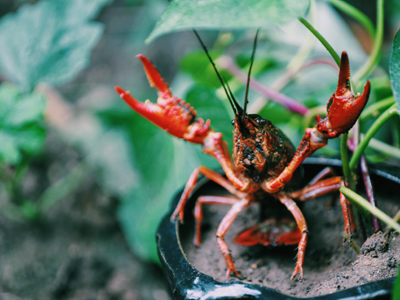
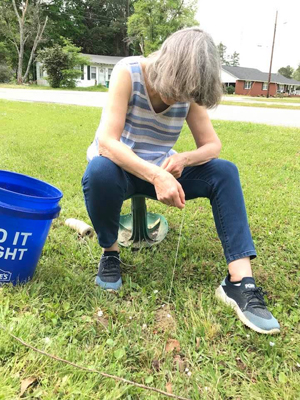
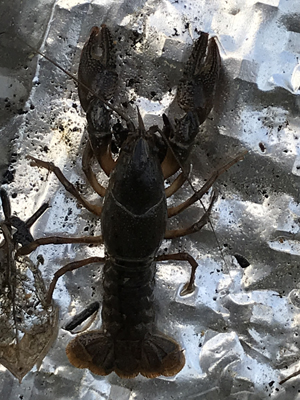
The image on the left is a crawdad chimney from the back yard. The center picture shows me fishing in a crawdad hole in my front yard where I got more nibbles. Notice that not all crawdad holes have mud chimneys around them. The third picture is the crawdad I caught. Since only one wasn’t enough for a meal, I released it back into its hole along with the leftover scrap of bacon. It deserved at least that for all his/her troubles trying to eat it.
These freshwater critters go by many names: crayfish, crawfish, crawdads, craydads, crawdaddies, mudbugs, and yabbies. All are classified as crustaceans and are very similar to shrimp. The crayfish found in holes like the ones in my yard are referred to as burrowing crayfish. They are found in many parts of the USA in low lying moist ground where the water table is close to the surface.
Burrowing crayfish are nocturnal, so unless you coax them out of hiding with some bait on a string, you probably won’t see one. They dig their burrows in wet soil and pile up little mud balls on the top of the ground around their hole to make their mud chimneys. I like to think of burrowing crayfish as little knights in armor, and the mud chimneys are their castles.
It took me about three hours to catch my crawdad. If I’d been smarter, I would have looked on YouTube first. I would have found this video made by nitro3899 telling how to catch them. I might have caught mine and maybe a couple more in about a half an hour. I didn’t know to fill the hole with water or to grab the crawdad with needle nose pliers. My crawdad wouldn’t stay on the bait all the way out of the hole, until I eventually wore him out.
Now that you know what to look for, keep some string and needle nosed pliers handy for when you chance to find some mud chimneys. You can use any kind of meat on your string. Your children or grandchildren will love the adventure.
Have you tried this with your children? Tell me about it in the comments below.