
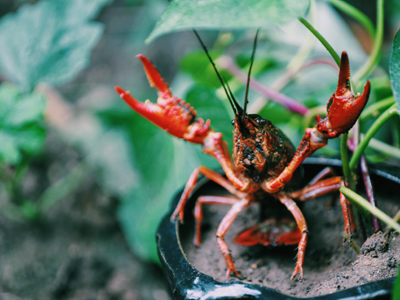
This post was originally written for Christian Children’s Authors blog. I needed a post for April 17. When I discovered that April 17th was National Crawfish Day, I knew it was time to check off one thing that had been on my bucket list for years – to catch a crawdad in a crawdad hole.
Everyone knows about finding crawdads in creeks and ditches, but did you know you could catch one in a hole in the ground with a string and some bacon?
Many years ago when my now-grown daughter (Jonathan’s mom) was very young we saw several funny looking chimneys made of mud in our back yard. Not knowing what they were, we asked around and were told that they were made by crawdads that lived under the ground. I often wondered if I could catch one with some bait on a string, but I never got around to trying it. Many years later in a different home in a different town, I noticed mud chimneys in our ditch.
It was time to find out if it really worked. Check out my pictures!
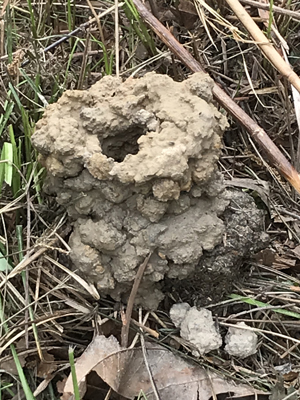
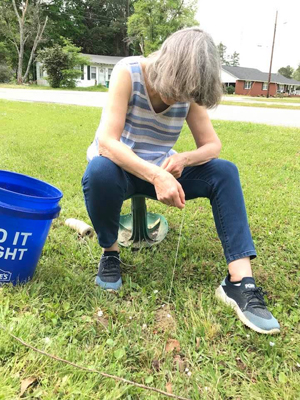
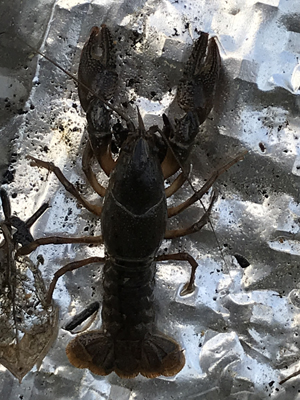
The image on the left is a crawdad chimney from the back yard. The center picture shows me fishing in a crawdad hole in my front yard where I got more nibbles. Notice that not all crawdad holes have mud chimneys around them. The third picture is the crawdad I caught. Since only one wasn’t enough for a meal, I released it back into its hole along with the leftover scrap of bacon. It deserved at least that for all his/her troubles trying to eat it.
These freshwater critters go by many names: crayfish, crawfish, crawdads, craydads, crawdaddies, mudbugs, and yabbies. All are classified as crustaceans and are very similar to shrimp. The crayfish found in holes like the ones in my yard are referred to as burrowing crayfish. They are found in many parts of the USA in low lying moist ground where the water table is close to the surface.
Burrowing crayfish are nocturnal, so unless you coax them out of hiding with some bait on a string, you probably won’t see one. They dig their burrows in wet soil and pile up little mud balls on the top of the ground around their hole to make their mud chimneys. I like to think of burrowing crayfish as little knights in armor, and the mud chimneys are their castles.
It took me about three hours to catch my crawdad. If I’d been smarter, I would have looked on YouTube first. I would have found this video made by nitro3899 telling how to catch them. I might have caught mine and maybe a couple more in about a half an hour. I didn’t know to fill the hole with water or to grab the crawdad with needle nose pliers. My crawdad wouldn’t stay on the bait all the way out of the hole, until I eventually wore him out.
Now that you know what to look for, keep some string and needle nosed pliers handy for when you chance to find some mud chimneys. You can use any kind of meat on your string. Your children or grandchildren will love the adventure.
Have you tried this with your children? Tell me about it in the comments below.
#outsideabcs